
When Roland released the SH-101 back in 1982, it wasn’t marketed as a flagship or even a particularly glamorous instrument. It was designed as an affordable, approachable monosynth. Yet, decades later, the SH-101’s rubbery basslines, snappy envelopes, and no-nonsense slider interface have become the stuff of legend.
Original 101s now command eye-watering secondhand prices, well beyond the £249 it sold for at launch. Thankfully, a new generation of clones, homages, and evolutions have stepped up to give musicians access to that iconic sound.
Into this crowded field comes Donner’s Essential L1, a bold analog monosynth that sits somewhere between faithful recreation and modern reimagining.
Is this the affordable analogue powerhouse you’ve been waiting for, or a flawed experiment with too many compromises?
Design and First Impressions
At first glance, the L1 makes an impression. Its all-black front panel, with neat rows of sliders and switches, is unmistakably inspired by the SH-101 yet given a modern polish. It feels less toy-like than Donner’s earlier B1 Bass Synthesizer, a 303 clone that delivered more sonically than its bland office-equipment looks suggested.
The L1 comes in two parts: a compact desktop synth module and the optional KB-32M detachable keyboard. Held together magnetically, this setup is intended to offer the best of both worlds: portable desktop module when you need it, or standalone instrument when you want to play hands-on.
It’s an ambitious idea, but not without issues. The magnetic connection is fine when the synth sits on a flat surface, but less reassuring if you pick the unit up or rest it on your lap. Gigging musicians may not trust it to stay put. The keyboard itself is light, plastic, and equipped with mini keys, but feels solid enough and pleasantly responsive for its size.
At around €450 / £400 for the full bundle, Donner clearly wants to compete with Behringer’s MS-1 and Roland’s Boutique SH-01A. That pricing, though, sets expectations high.
Sound Engine: Classic Core with Modern Tweaks
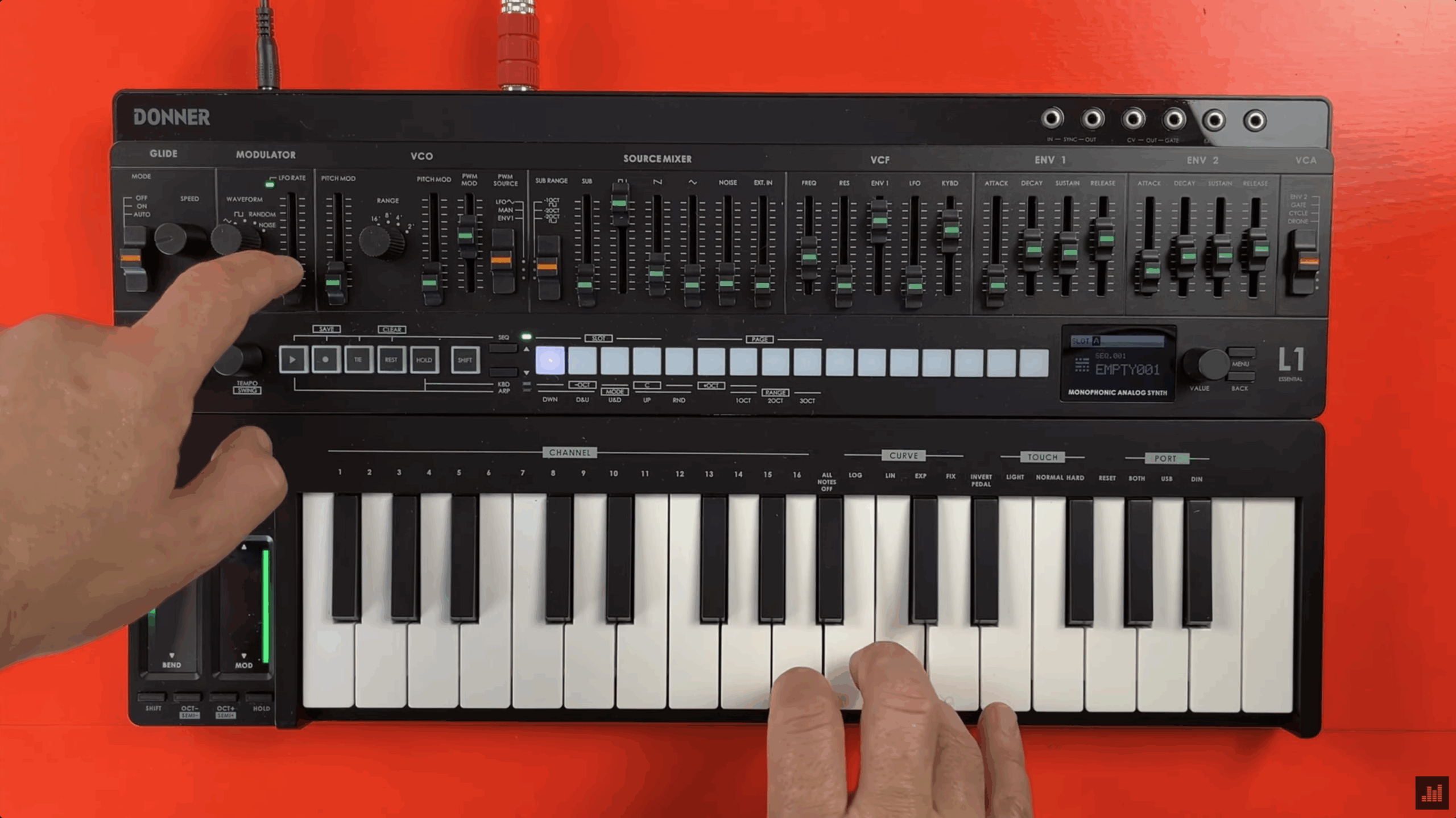
Of course, the heart of any synth is its sound. Here, Donner has done impressive work. The oscillator architecture is classic 101: pulse wave with PWM, saw, sub-oscillator, and noise.
Donner adds a welcome triangle wave, opening up additional tonal variety.
And of course you can mix all of these sounds together to make your own sounds.
The filter is a low-pass design that self-oscillates beautifully. Push the resonance and you get that unmistakable acidic edge; dial it back and the synth produces warm, rounded tones that sit well in a mix.
PWM, sub-oscillator heft, and the glide function all contribute to the raw, rubbery sound we associate with the original SH-101. Donner’s oscillator chips and filter design feel authentic enough that long-time 101 fans will nod in recognition.
Not everything is perfect. The noise generator sounds softer and less convincing than the original, and background hiss from the digital display bleeds into the audio path. It’s subtle when the oscillators are cranked but becomes noticeable with quieter patches. This quirk may frustrate those chasing pristine audio.
Envelopes and Modulation
One of the L1’s biggest upgrades over the SH-101 is the addition of a second ADSR envelope. On the original, a single envelope controlled both filter and amplitude. Here, you can assign one envelope to the filter and the other to the VCA, allowing for far more complex shaping.
Donner provides multiple amp trigger modes:
- Env 2 mode: independent control of filter and amp.
- Gate mode: organ-like instant on/off response.
- Cycle mode: LFO-linked pulsing patterns.
- Drone mode: endless sustained sound with no key required.
This flexibility is one of the L1’s strongest features, letting you go from classic 101 snappiness to more experimental drones and rhythmic textures.
The LFO also deserves praise. It can sync to internal or external clock and extend into audio-rate territory, unlocking FM-style tones and aggressive filter modulation. This is a significant creative expansion over the original.
Sequencer and Arpeggiator
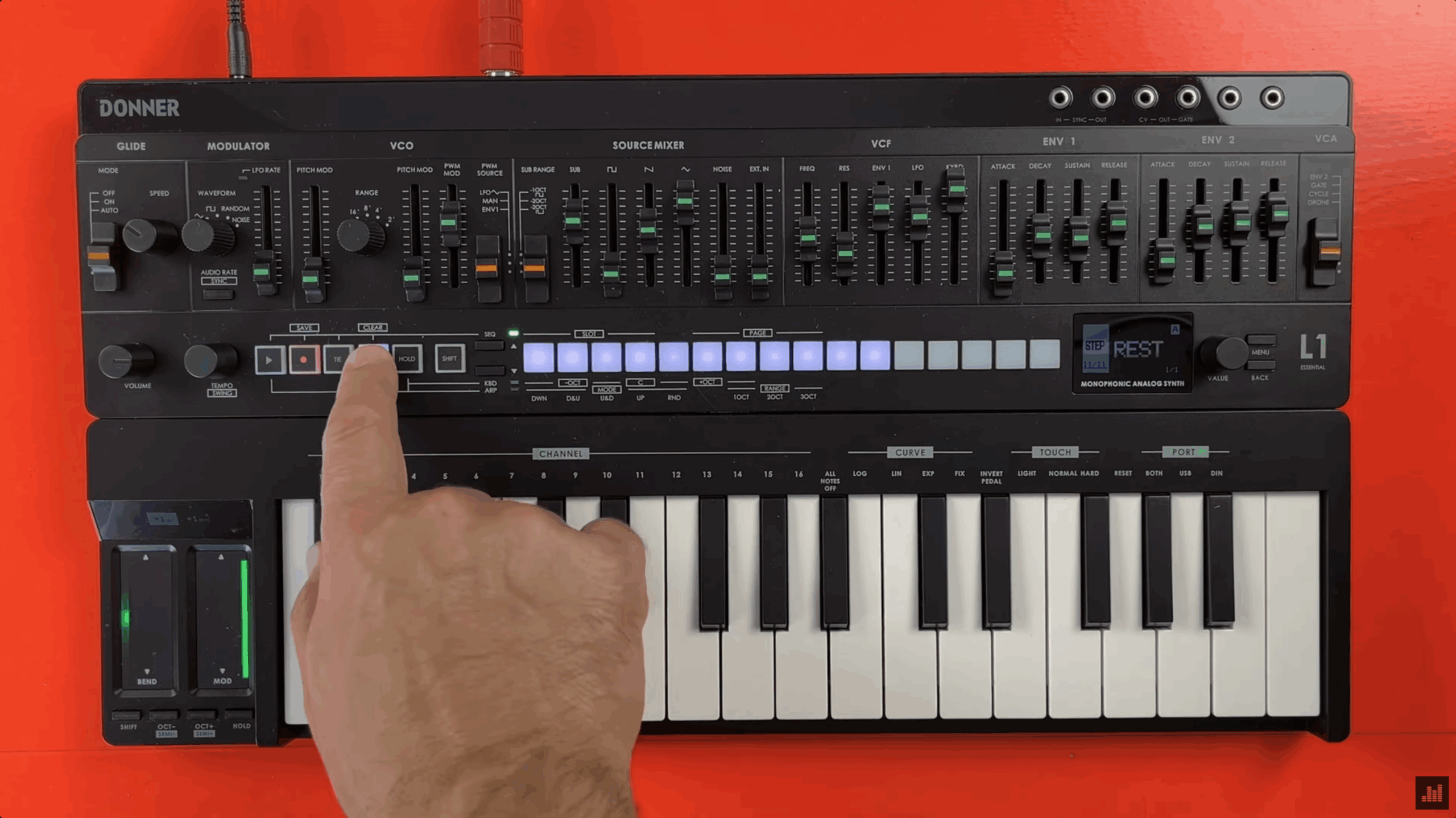
The SH-101 sequencer was primitive but beloved, a simple step-entry tool that gave riffs a machine-like feel. Donner keeps the spirit alive but adds depth.
The L1’s sequencer supports up to 64 steps, with storage for 128 patterns and 32 songs. The OLED screen, while tiny, helps manage sequences and songs more easily than the old blind step-entry method. There’s also an arpeggiator with multiple modes. (DEMO)
For solo jamming and quick inspiration, the sequencer and arp are fun and capable.
It’s a shame, however, that there’s no patch memory. Sequences save, but sounds don’t. Purists may argue this is authentic to the SH-101 experience, but with a digital screen onboard, the omission feels like a wee bit of a missed opportunity.
Connectivity
On the back panel, connectivity is a mixed bag.
You get:
- External audio input (great for processing other instruments through the filter).
- MIDI in/out, though only via 3.5mm rather than five-pin DIN.
- USB-C, used for MIDI and firmware updates (but not power).
What you don’t get:
- CV/Gate inputs for modular integration.
- Five-pin MIDI.
- USB power.
The KB-32M keyboard adds a sustain pedal input and can function as a USB-MIDI controller in its own right, which is a nice touch. But the lack of CV/Gate feels like a bit of an oversight
Build Quality and Interface
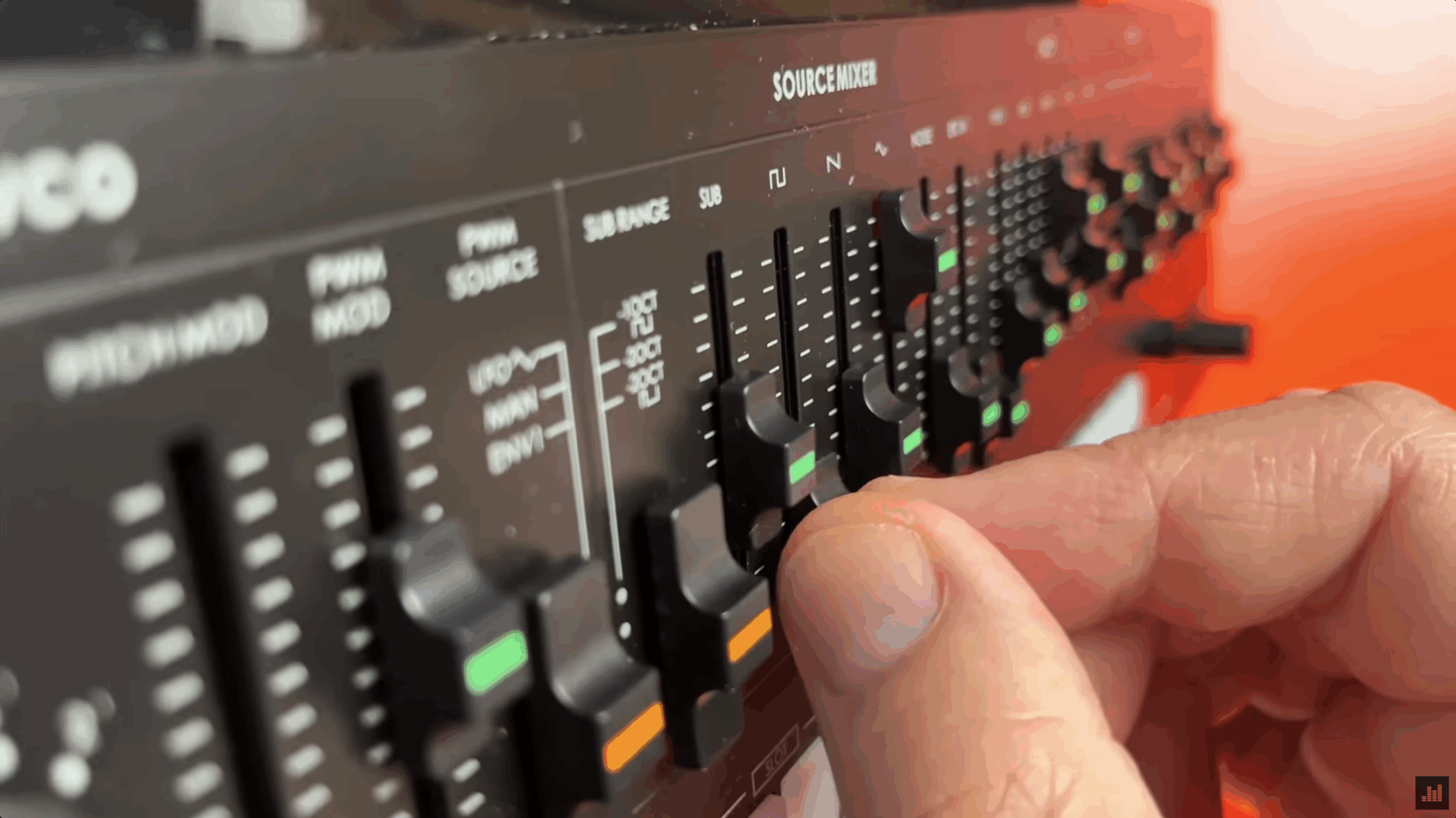
The L1 is compact and lightweight, which makes it portable but also means it feels plasticky. Sliders wobble a little, knobs are firm and have a satisfying click to them, but they are definitely not luxurious, and the overall impression is more budget than boutique.
That said, the layout is superb. Like the SH-101, the L1’s left-to-right slider design is an intuitive masterclass in subtractive synthesis. Beginners can quickly grasp how oscillator shapes, filter settings, and envelopes interact. Experienced players will appreciate how fast it is to dial in tones.
This immediacy is fantastic and makes using the L1 to make sounds really good fun.
The L1 as a Beginner’s First Hardware Synth
One of the most important questions with any affordable monosynth is whether it can serve as a first step into hardware for someone coming from software instruments, or perhaps from no prior synthesis background at all. On this front, the Donner Essential L1 actually makes a strong case for itself.
The original SH-101 became a classic partly because it was so straightforward to use. Its panel design is effectively a visual tutorial in subtractive synthesis, laid out left-to-right in logical signal flow.
Donner has wisely kept this approach intact, and for beginners, that clarity is invaluable. Start at the oscillator section, raise a slider to hear a waveform, combine a saw with a sub, then move right to the filter, and you immediately grasp how each stage shapes the sound. The tactile nature of sliders reinforces the learning process — you see and feel the changes as you make them. Compared to diving through menus on a digital synth, this simplicity is far more approachable.
The added second envelope and multiple amp modes expand the possibilities without overwhelming the user. In fact, they provide an ideal bridge from beginner to intermediate. At first, you might just stick with the default settings and explore basic filter sweeps or snappy basslines. Later, when you’re comfortable, you can start experimenting with the drone mode or using independent envelopes for filter and amplitude, unlocking far more sophisticated sound design. It’s the kind of synth that grows with you, rather than outpacing you from day one.
The sequencer and arpeggiator also help beginners create satisfying results quickly. You don’t need to be a skilled keyboard player to get the L1 singing. Punch in a simple step sequence, tweak the filter, and you’ve got an instant riff. Beginners can sometimes be discouraged if a synth feels like it demands virtuosity before producing musical results, but the L1’s tools ensure you get that buzz of creativity early on.

That said, there are caveats. The lack of patch memory means beginners will lose sounds unless they learn to document settings manually or commit parts to audio. While this is authentic to vintage workflows, it can feel frustrating if you’re new to synthesis and stumble on a sound you love, only to lose it when you move a slider. Similarly, the noise bleed issue could confuse inexperienced users who might assume they’re doing something wrong when they hear hiss at low levels.
The build quality is another factor. Beginners buying their first synth often want something that feels solid and dependable. The L1’s plasticky sliders and lightweight construction don’t exactly inspire confidence, even if they are functional. For a home studio learner, that may be less of an issue, but anyone hoping to gig with their first hardware synth might feel limited.
Despite these flaws, the L1 remains an appealing gateway. It teaches synthesis fundamentals in a hands-on way, sounds authentic enough to satisfy, and comes with creative tools that can inspire without requiring years of experience. The detachable keyboard concept adds versatility too.
In short, while it’s not flawless, the Donner Essential L1 is actually a very good candidate for someone’s first hardware synth. It balances immediacy and depth, encourages exploration, and captures the fun of hardware without the intimidation factor. Yes, there are cheaper entry-level options, and yes, the quirks may frustrate some newcomers, but as a starting point into the tactile world of analog synthesis, the L1 is an accessible and musically rewarding choice.