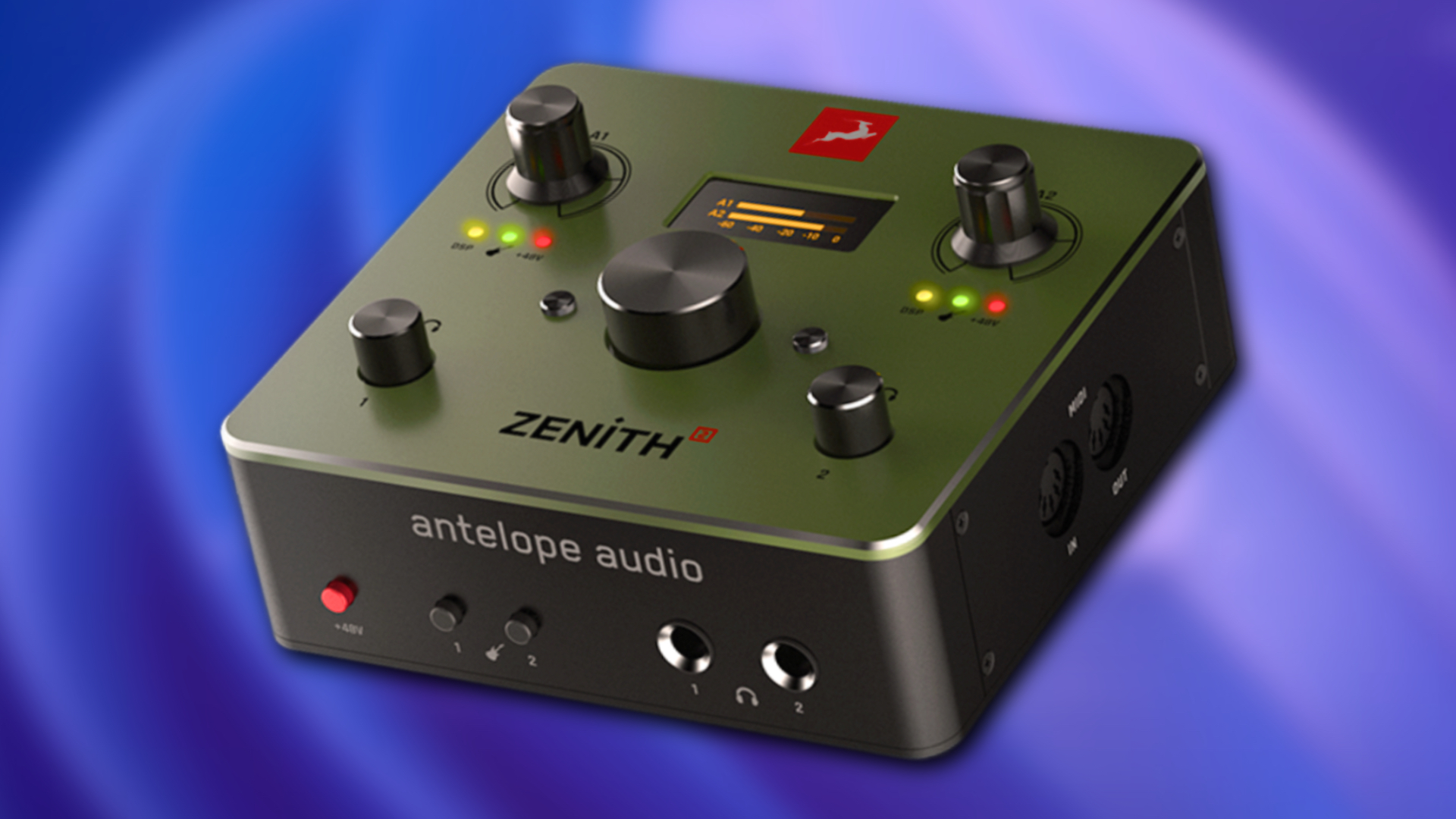
If you’re in the market for a compact, affordable audio interface in 2026, you are not short on options.
Focusrite, Audient, SSL… the usual suspects all offer solid entry-level interfaces that cover the basics well. For most people, the differences between them come down to small details rather than anything transformative.
That’s what makes the Antelope Audio Zenith 2 interesting.
On paper, it sits in that same price bracket. In practice, it offers a few features and design choices that you simply don’t tend to see at this level.
After spending some time using it across Mac, iPad and iPhone setups, here are five reasons why the Zenith 2 stands out.
It Sounds Better Than It Probably Should
Let’s start with the most important thing.
The Zenith 2 sounds genuinely good.
You get two combo XLR / 1/4-inch inputs, each with phantom power, line-level support and Hi-Z mode for instruments.
Antelope Audio have used discrete, console-style preamps here, based on designs from their higher-end interfaces. The result is a noticeably more refined input stage than you’d expect at this price.
There’s up to 75 dB of gain available, which means you can comfortably run gain-hungry microphones like the Shure SM7B or RØDE Procaster without needing an external booster.
Then there’s the dynamic range. At up to 123 dB, the Zenith 2 moves into territory usually reserved for more premium gear. In practice, that translates to cleaner recordings, more detail in your source material, and more usable headroom when tracking.
The Build Quality Feels Like a Step Up
There is a noticeable difference between something that works and something that feels built to last.
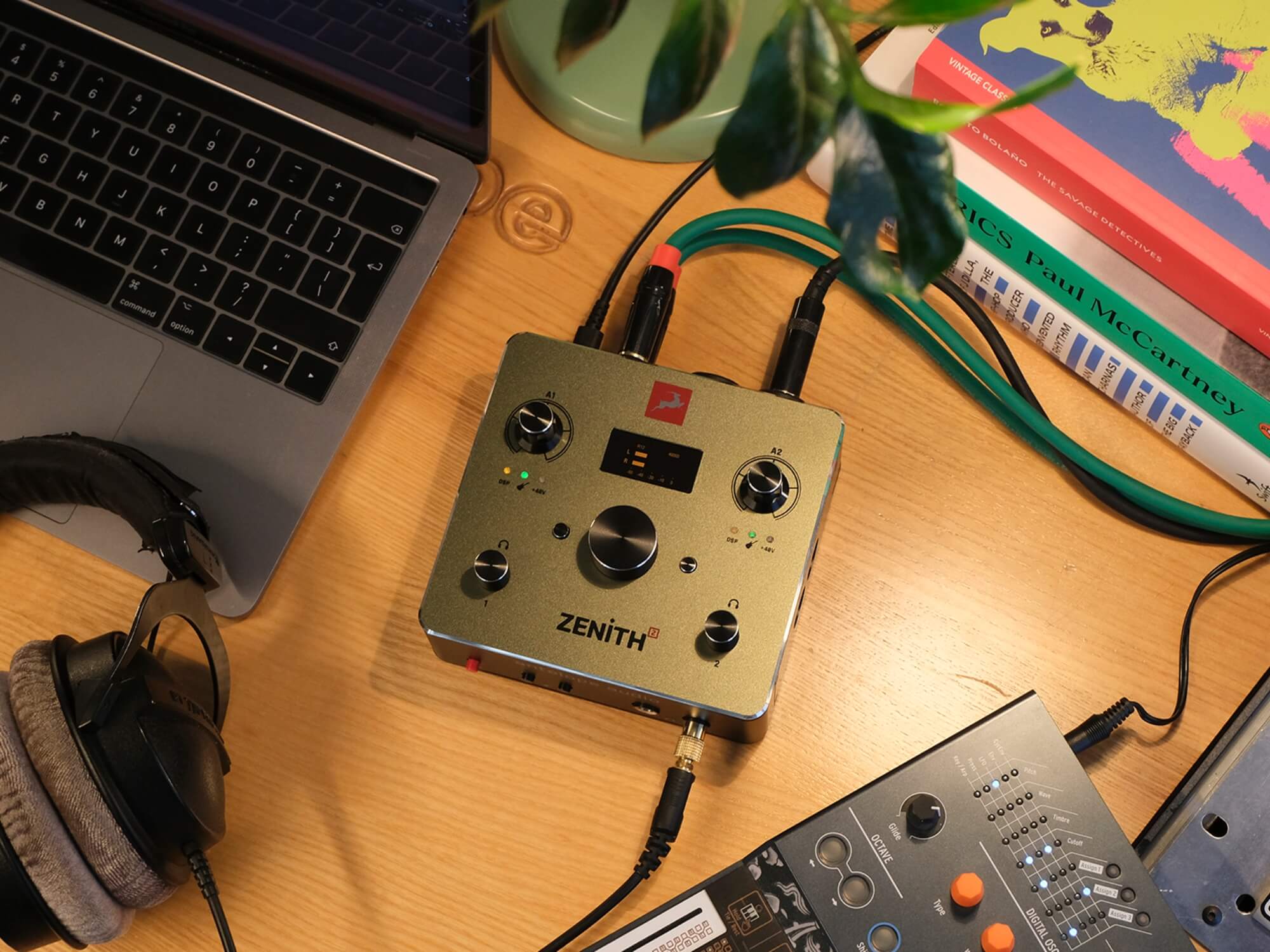
The Zenith 2 falls firmly into the second category.
The unit is housed in a full metal chassis with a reassuring amount of weight to it. It feels solid on a desk and equally at home being thrown into a bag for a mobile setup.
The physical layout is also well thought through.
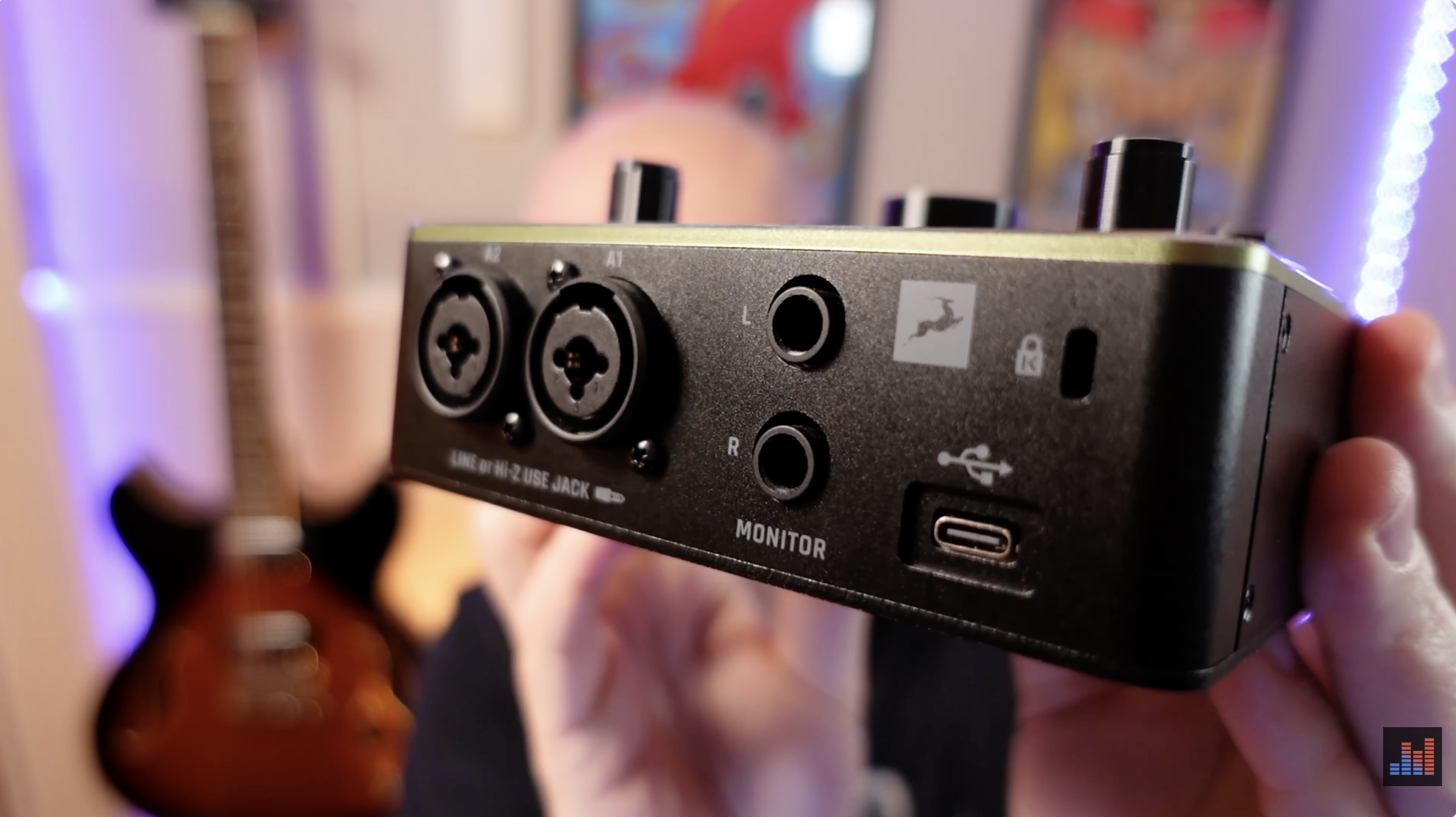
On the rear, you get:
- two combo inputs
- stereo TRS monitor outputs
- USB-C for power and data
- and a Kensington lock
The side panel adds 5-pin MIDI in and out, which is still surprisingly rare on smaller interfaces.
On the front are:
- dual headphone outputs
- a global 48V phantom power switch
- and individual Hi-Z switches for each input
The dual headphone outputs are particularly useful. Both have independent volume controls, and both are capable of driving higher-impedance headphones without issue. If you are recording with someone else, that is one less compromise in your setup.
On top, things get more interactive.
You’ve got dedicated gain knobs for each input, a central display, and a big old knob for navigating menus and adjusting settings. LEDs clearly show phantom power, Hi-Z mode, and whether onboard effects are active.
The display itself doubles as a metering system by default, and can be switched between inputs and outputs. It also acts as your access point for deeper features like loopback and DSP effects.
It feels tactile, considered, and far more hands-on than many interfaces in this price bracket.
Built-In DSP Effects
This is where the Zenith 2 separates itself from most of its direct competitors.
It includes onboard DSP effects that can be applied to your signal before it reaches your DAW.
From the interface’s menu system, you can apply different processing chains to each input, including:
- high-pass filtering
- opto-style compression
- de-essing
- high-frequency EQ shaping
There is also a dedicated guitar mode with amp and cabinet simulations, alongside a set of presets that combine multiple effects for common use cases like vocals, instruments, and podcasting.
According to the user manual, these effects are handled directly on the interface via built-in DSP, meaning they can be applied in real time without adding noticeable latency
Instead of capturing everything completely dry and fixing it later, you can shape your sound as you go. A vocal can already feel balanced and controlled while tracking. A guitar can sit closer to its final tone from the outset.
It is faster, more intuitive, and often leads to better results.
It Works Across Pretty Much Any Setup
Flexibility is another strong point.
The Zenith 2 is class-compliant and bus-powered over USB-C. That means no drivers are required to get up and running on most systems.
It works with:
- macOS
- Windows
- USB-C iPads
- USB-C iPhones
- and even Android devices, depending on compatibility
There is an initial activation step via Antelope’s software, but once that is done, the interface behaves exactly as you would expect.
For iPad and iPhone users in particular, this is a strong pairing.
Because the DSP effects run on the interface itself, you are not relying on your device to handle additional processing. That keeps performance smooth and avoids pushing mobile setups too far.
The interface also supports high-resolution audio up to 32-bit / 192kHz with multiple input and output channels over USB.
A Software Bundle That Actually Adds Value
Most audio interfaces ship with some form of bundled software.
Often, it is serviceable rather than exciting. Antelope Audio have taken a different approach here.
With the Zenith 2, you get:
- Three months access to Antelope’s Cosmos plugin suite, featuring over 75 effects
- Bitwig Studio Essentials
- Excite Audio’s Lifeline Lite bundle
That is a genuinely useful starting point, especially for newer producers building out their toolkit.
It complements the hardware rather than feeling like an afterthought.
Final Thoughts
The Antelope Audio Zenith 2 does the fundamentals well.
It sounds good.
It is well built.
It offers the inputs and outputs most people need.
But what makes it stand out is everything around those basics.
The onboard DSP effects change how you approach recording. The build quality feels closer to higher-end gear. The cross-platform support makes it easy to integrate into modern workflows.
At around €250, it is a strong package.
There are plenty of good audio interfaces in this price range. Very few offer this combination of sound quality, features, and flexibility.
For home studios, mobile setups, and content creators alike, the Zenith 2 is worth serious consideration.