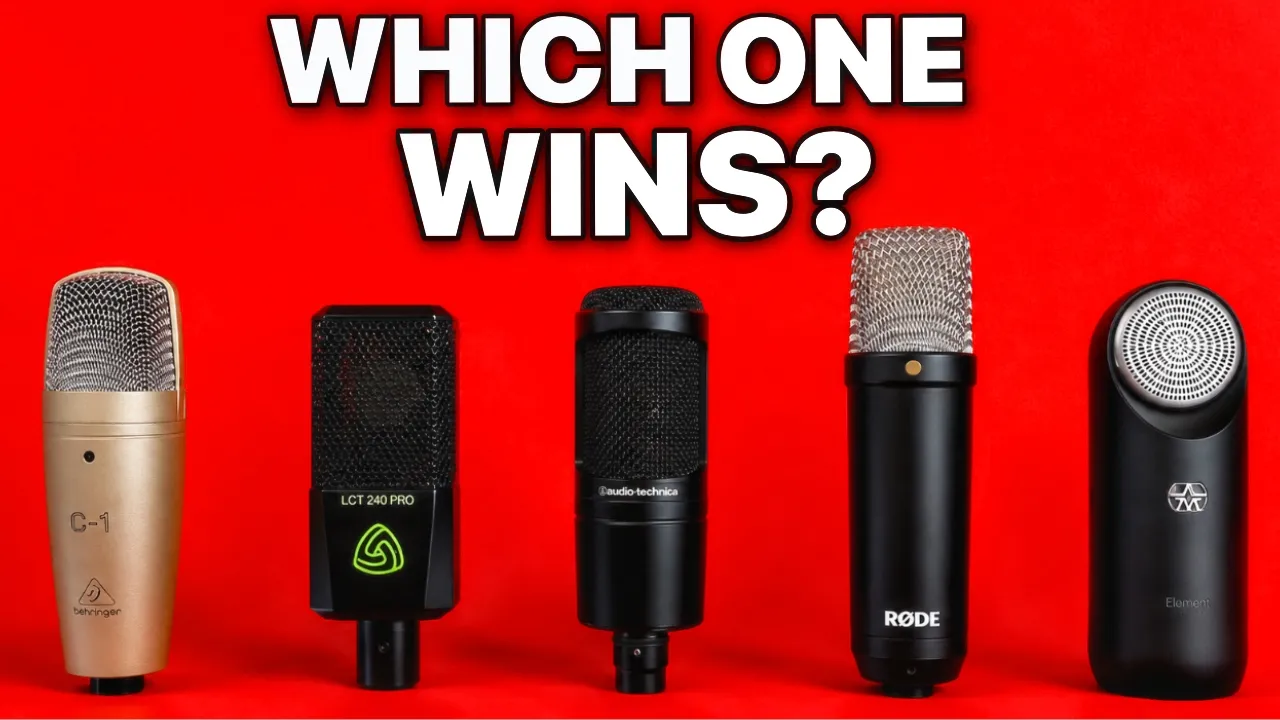
You don’t need to spend hundreds on a microphone to get great quality recordings at home.
There are some genuinely excellent condenser microphones available for well under £150, including models that are good enough to remain part of your recording setup for years.
The tricky part is choosing one.
I’ve used all five of the microphones in this guide extensively, recording vocals, acoustic instruments, voiceovers and more. They cover a range of budgets, starting with the incredibly affordable Behringer C-1 and working up to the RØDE NT1 Signature Series.
So, which budget condenser microphone should you buy?
Microphone prices change regularly, so the prices mentioned throughout this article should be treated as a rough guide.
Behringer C-1: Best Condenser Microphone Under £50
Best for: Beginners on a very tight budget
The Behringer C-1 has been around for years and remains one of the cheapest ways to add a proper XLR condenser microphone to your home studio.
Despite the low price, it doesn’t feel particularly cheap.
The C-1 has an all-metal body and grille and my own microphone has held up remarkably well over the years. There aren’t any controls, filters or other extras to worry about either. Connect it to your audio interface, switch on 48V phantom power and you’re ready to record.
It uses a cardioid polar pattern, making it suitable for recording vocals, acoustic instruments, voiceovers and plenty more.
How does the Behringer C-1 sound?
For the money, surprisingly good.
Compared with the more expensive microphones in this guide, I find there’s a little more roughness in the C-1’s top end, particularly when recording vocals.
That said, we’re talking about an incredibly inexpensive microphone. With sensible positioning and a little processing afterwards, the C-1 is capable of producing perfectly usable recordings.
Accessories are fairly limited, so you’ll need to provide your own XLR cable and I’d strongly recommend picking up a pop filter if you’re planning to record vocals.
If you have less than £50 to spend, the C-1 is still easy to recommend.
Spending more will get you a better microphone, but if your budget simply won’t stretch any further, the C-1 gives you everything you need to start making proper XLR microphone recordings.
Check the latest Behringer C-1 price
Audio-Technica AT2020: The Proven All-Rounder
Best for: Someone looking for a versatile first studio microphone
The Audio-Technica AT2020 has been one of the standard recommendations for an affordable condenser microphone for a very long time.
There’s a good reason for that.
I’ve owned my AT2020 for years and used it to record vocals, acoustic instruments, voiceovers and all sorts of other things. Apart from a small dent in the grille, it’s still going strong.
Build quality is excellent, with an all-metal construction and enough weight to make it feel reassuringly substantial.
Like the C-1, the AT2020 keeps things simple. It has a fixed cardioid polar pattern with no additional switches or controls.
How does the Audio-Technica AT2020 sound?
I’ve always particularly liked the AT2020 on acoustic guitar.
It’s easy to position and get a nicely balanced recording, without introducing too much of the scratchy high-frequency sound that acoustic guitar recordings can sometimes suffer from.
It works very well on vocals too, with plenty of presence and detail.
The package itself is fairly basic. You get the microphone, a stand mount and a soft storage pouch, so an XLR cable and pop filter will probably need to be factored into your budget.
There’s a lot more competition around the AT2020 these days, but it’s still a very solid choice.
It’s particularly appealing when you find it discounted. If you’re looking for one microphone capable of handling a wide range of home recording jobs, the AT2020 remains a dependable option.
Check the latest Audio-Technica AT2020 price
Aston Element: The Wildcard
Best for: Acoustic instruments and anyone looking for something a little different
The Aston Element is easily the most unusual microphone in this comparison.
Aston developed the Element with input from thousands of musicians, producers and engineers, including blind listening tests during the microphone’s development.
It uses Aston’s unusual Ridyon capsule technology, combining characteristics associated with condenser, dynamic and ribbon microphone designs.
In practical terms, though, it’s straightforward to use. Connect it to an audio interface via XLR, supply phantom power and start recording.
You also get a useful selection of accessories, including a shock mount and Aston’s excellent magnetic pop filter.
How does the Aston Element sound?
The Element has quite a distinctive midrange character.
Personally, I’ve always preferred it on acoustic instruments. There’s a character to the Element that works nicely on acoustic guitar and separates it from some of the more neutral microphones here.
I’m less convinced by it on my own voice, where I usually find myself wanting to make a few more EQ adjustments afterwards.
Your results could be completely different. Microphones interact with individual voices differently, which makes listening to comparisons particularly useful before buying.
The Element isn’t my first recommendation for most beginners, but that’s not necessarily a criticism.
It has a distinctive sound, comes with some good accessories and can be particularly effective on acoustic instruments.
If you find one at a good price and like what you hear from it, it’s well worth considering.
Check the latest Aston Element price
LEWITT LCT 240 PRO: Best Condenser Microphone Around £100
Best for: Vocals, instruments, voiceover and general home studio recording
The LEWITT LCT 240 PRO has been one of my favourite affordable condenser microphones for quite a while.
At around the £100 mark, you’re getting an exceptionally well-made microphone. Its all-metal construction feels reassuringly solid and considerably more premium than its price might suggest.
The LCT 240 PRO uses a fixed cardioid polar pattern and is straightforward to set up and use.
How does the LEWITT LCT 240 PRO sound?
This is where the LEWITT really stands out for me.
It’s one of the most natural sounding microphones in this comparison, with plenty of detail without becoming overly harsh in the high frequencies.
I’ve had good results recording both vocals and acoustic instruments with it.
It’s also an excellent option if your microphone needs extend beyond music production. I’ve happily used the LCT 240 PRO for voiceovers, making it a good choice for YouTube videos, podcasts, streaming and other spoken-word recording.
For vocals and voiceover, I’d recommend using a pop filter.
For around £100, this would be my recommendation for most people.
It sounds excellent, it’s beautifully made and it’s versatile enough to handle most of the recording jobs you’re likely to encounter in a small home studio.
You can certainly spend less and still get good results. If your budget stretches to the LCT 240 PRO, though, I think the additional investment is worthwhile.
Check the latest LEWITT LCT 240 PRO price
RØDE NT1 Signature: Best Budget Condenser Microphone Overall
Best for: Someone looking for a microphone they can keep for years
At the top of our budget is the RØDE NT1 Signature.
The NT1 has been a familiar name in recording studios for decades, and the Signature version continues to offer an impressive amount of microphone for the money.
The package is particularly good.
RØDE includes its SM6 shock mount and pop filter along with an XLR cable, so someone putting together their first recording setup won’t have as many additional accessories to buy.
Build quality is excellent and the microphone is available in several different colours, although I’ve stuck with the rather more sensible black version.
How does the RØDE NT1 Signature sound?
Excellent.
There’s loads of detail here, particularly when recording vocals, without my voice becoming excessively harsh or sibilant.
The NT1 Signature is also exceptionally quiet, with RØDE quoting self-noise of just 4dBA. That’s particularly useful when recording quieter sources where you’ll need to use more gain.
At the opposite end of the scale, it can handle very loud sources too, making it suitable for recording everything from quiet acoustic instruments and vocals to loud guitar amplifiers.
It’s an extremely versatile studio microphone.
If my budget could stretch to it, this is the microphone I’d probably choose from the five.
The sound quality is excellent, the included accessories add genuine value and there’s plenty of scope to keep using the NT1 Signature as your recording setup develops.
For someone buying their first serious condenser microphone, I think it’s worth spending the extra money.
Check the latest RØDE NT1 Signature price
Which Budget Condenser Microphone Should You Buy?
All five microphones in this guide are capable of producing good recordings, but I’d narrow the decision down based on how much you want to spend.
If £50 is your absolute limit, get the Behringer C-1. It’s remarkably capable considering how little it costs.
The Audio-Technica AT2020 remains a dependable all-rounder and becomes particularly attractive when you can find it discounted.
The Aston Element is more of a wildcard. I particularly like it on acoustic instruments, although I’d listen to some vocal examples before deciding whether its character suits your voice.
At around £100, my pick is the LEWITT LCT 240 PRO. It’s the sweet spot of this group for me, combining excellent sound quality, great build quality and enough versatility to cover music, voiceover, podcasting and video work.
If you can spend a little more, the RØDE NT1 Signature is a great choice. It’s the microphone I’d choose if I wanted something that could remain at the heart of my home recording setup for years.
You can also find my current audio interface, microphone, headphone and MIDI keyboard recommendations on my Home Studio Gear page.